
RoboXCraft: Empowering College Students with Robotics and IoT Projects

RoboXCraft Arduino Project Kits
It is a one-stop destination for electronics, robotics, and IoT project kits. In fact, the site advertises that it sells “all IoT components and project kits”roboxcraft.com. Many of these kits center on Arduino – an open-source microcontroller platform with easy-to-use hardware and softwarearduino.cc. An Arduino board can read inputs (sensors, switches, even online data) and turn them into outputs (motors, LEDs, etc.)arduino.cc.
Roboxcraft
This accessibility has made Arduino ubiquitous in education: as the Arduino site notes, “teachers and students use it to build low cost scientific instruments… [and] to get started with programming and robotics”arduino.cc. RoboxCraft leverages this by offering Arduino Project Kits and DIY kits aimed at college students and hobbyists, providing all the parts (sensors, boards, actuators) needed to build projects from scratch.
Smart Dustbin Project Example
One flagship project is the Smart Dustbin – an automated trash bin that opens its lid when someone approaches. In this kit, an ultrasonic range sensor (e.g. HC-SR04) detects an object within a set range, and a micro-servo motor lifts the lid. As one Arduino tutorial shows, you can “build a smart dustbin that opens automatically using an ultrasonic sensor and an Arduino UNO”projecthub.arduino.cc. In that example, the lid opens when an object is within about 20 cm. A snippet of code uses the HC-SR04 sensor to measure distance and the SG90 servo to turn the lidprojecthub.arduino.cc. College students can assemble such a kit to learn how sensors and microcontrollers create useful devices. (Many RoboXCraft Complete Kits include similar components.)
Components
Beyond ultrasonic sensors, some smart-automation projects use PIR motion detectors. A PIR (Passive Infrared) sensor detects infrared radiation (body heat) from moving objects. When it “recognize[s] infrared light emitted by moving objects,” it outputs a signal that can trigger lights, alarms, or actuatorsuk.rs-online.com. In practice, a PIR motion sensor can detect a person walking by and send a signal to an Arduino to, say, turn on an LED or pump. These sensors are cheap and common in security or automation kits.
Key Components for DIY Robotics
Robotics and electronics projects rely on many common parts. Below are some popular components and terms (keywords) often found in RoboxCraft kits and tutorials:
Module Relay (5V Relay): A relay module is an electrically operated switch. It allows a microcontroller (like Arduino) to control high-power circuits. As one guide explains, “a relay is an electrically operated switch… [that] can be controlled with low voltages, like the 5V provided by the Arduino pins”randomnerdtutorials.com. This lets your Arduino safely turn lights, motors, or other devices on and off. For example, a 5V relay board can switch AC or DC loads and often includes optical isolation and status LEDs to protect the controller.
PIR Motion Sensor Detector: This module detects movement of warm bodies. PIR sensors “recognize infrared light emitted by moving objects” and output a signal whenever motion is detecteduk.rs-online.com. They are widely used in security alarms, automatic lighting, and robotics. For instance, an Arduino-controlled robot could use a PIR to notice someone approaching and react accordingly. Because PIR detectors are low-cost and easy to interface, they are staples of introductory robotics kits.
1kΩ Resistor: A resistor is a component that impedes electric current. A 1kΩ (1 kilo-ohm) resistor is very common in circuits. It has a resistance of 1000 ohmsjotrin.com. Resistors are used to limit current and divide voltage. For example, a 1k resistor in series with an LED and a 5V supply will limit the LED’s current to a few milliamps. As one tutorial notes, “resistors are electronic components that impede the flow of electric current… the resistance value of a resistor determines how much it restricts the flow of electric current”jotrin.com. In kits and projects you’ll often use 1kΩ resistors for pull-ups or current-limiting.
Micro Servo Motor: Servos are small motors with built-in position control. A typical hobby micro servo (like the 9g SG90) is a “low-speed, high-torque motor” that can be positioned to a precise angledronebotworkshop.com. Unlike continuous motors, a servo only rotates about 0–180 degrees. Inside, it contains a DC motor, gearbox, potentiometer, and controller. Servos are controlled by PWM pulses from the microcontroller. They are “perfect if you need to position… robot appendages, cameras, or sensors” preciselydronebotworkshop.com. Students use micro servos in many RoboXCraft kits (for example, to move a robot’s steering or to open a lid in the smart dustbin).
Flying Robot (Drone): Small flying robots or quadcopters are increasingly popular projects. Building one typically involves all the above parts plus special items: a microcontroller or flight controller, sensors, motors, propellers, and a battery. For stabilization, drones often use an IMU sensor like the MPU-6050 (see below) to sense orientation. They are powered by rechargeable LiPo batteries (often around 2200mAh capacity for small drones) to provide enough energy for flight. (Larger capacity batteries give longer flight times, but add weight.) College students fascinated by robotics can build a flying robot kit, learning about motors, control loops, and power management.
2200mAh LiPo Battery: This refers to a Lithium Polymer rechargeable battery rated at 2200 milliamp-hours. LiPo batteries are compact and light for their energy, making them ideal for portable robots and drones. A 2200mAh pack can typically power a small quadcopter for several minutes of flight. RoboxCraft sells 11.1V 2200mAh LiPo batteries with connectors suited for RC drones and robots. (Battery care and safety are important – always balance-charge LiPo cells and monitor voltage during use.)
Hot Glue Stick (Hot-Melt Adhesive): Hot glue guns and sticks are a common crafting tool in electronics projects. As one DIY builder notes, hot glue is “an awesome semi-permanent material for electronics… It is an insulator, it sets quickly, and it can be peeled off if needed”instructables.com. Hobbyists use hot glue to fasten components, insulate exposed wires, or mount circuits. For example, you might hot-glue a sensor onto a board or add a dab to stabilize solder joints. The glue dries in seconds and provides mechanical support without soldering.
Mini Audio Amplifier: These are small amplifier boards that boost audio signals to drive speakers. For example, the PAM8406 module is a popular 5V “mini amplifier” that can deliver up to 5–10W per channeldocs.cirkitdesigner.com. Such class-D amplifiers are very efficient and stay cool, making them ideal for battery-powered audio projects. RoboXCraft offers mini amp boards so you can, for instance, amplify sound from an Arduino or Raspberry Pi output. Students might use them to build a small Bluetooth speaker or sound effects module for a robot.

Figure: MPU-6050 6-DOF accelerometer/gyro breakout (Adafruit). This tiny IMU sensor measures motion in spaceadafruit.com.
The MPU-6050 is a common inertial sensor module, integrating both a 3‑axis accelerometer and a 3‑axis gyroscope on one chipadafruit.com. The accelerometer detects acceleration and tilt (e.g. which way is down), while the gyro measures rotational velocity. By combining these readings, a robot or drone can track its orientation and motion in 3D space. DIY flying robots and balancing robots often use the MPU-6050 (or similar IMU modules) as part of their control systemadafruit.com. Robotics kits may include the MPU-6050 breakout shown above to let students experiment with sensing motion in their projects.
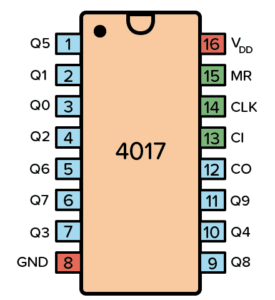

The CD4017 decade counter IC (often called “4017”) has 10 decoded outputs labeled Q0–Q9 and advances through them with each clock pulse. Hobbyists often use the 4017 to drive “running” LED patterns; for example, chaining LEDs from Q0 through Q9 creates a simple LED chaser. They also use it for sequencers, frequency dividers, and other timing tasks. By sending each pulse to a different output pin, students can sequence events in a circuit. RoboxCraft includes the 4017 IC in kits for light-sequencing projects.
Arduino & DIY Project Kits
RoboxCraft combines all these components into Arduino project kits or DIY robotics kits. Each kit bundles an Arduino board (Uno or Nano) with sensors, motors, wires, and detailed instructions. Kits such as “Arduino Line Following Robot” or “Obstacle Avoiding Robot” include motors, a chassis, sensors (line sensors or ultrasonic), and code guides. The Arduino platform targets students without an electronics background and is now used by thousands of learners. By following a kit guide, a college student can assemble the hardware, upload Arduino code, and debug the robot step by step. Keywords like Arduino project kits, DIY kits, project kits, or diy robotic kits highlight these educational bundles.
Arduino
Whether students build a smart dustbin, a flying robot, or a custom gadget, RoboXCraft components and kits transform theoretical learning into hands-on experience. Students develop practical skills in electronics, programming, and problem-solving by assembling a kit and using the parts.
Your Blogs are amazing,Keep going man…